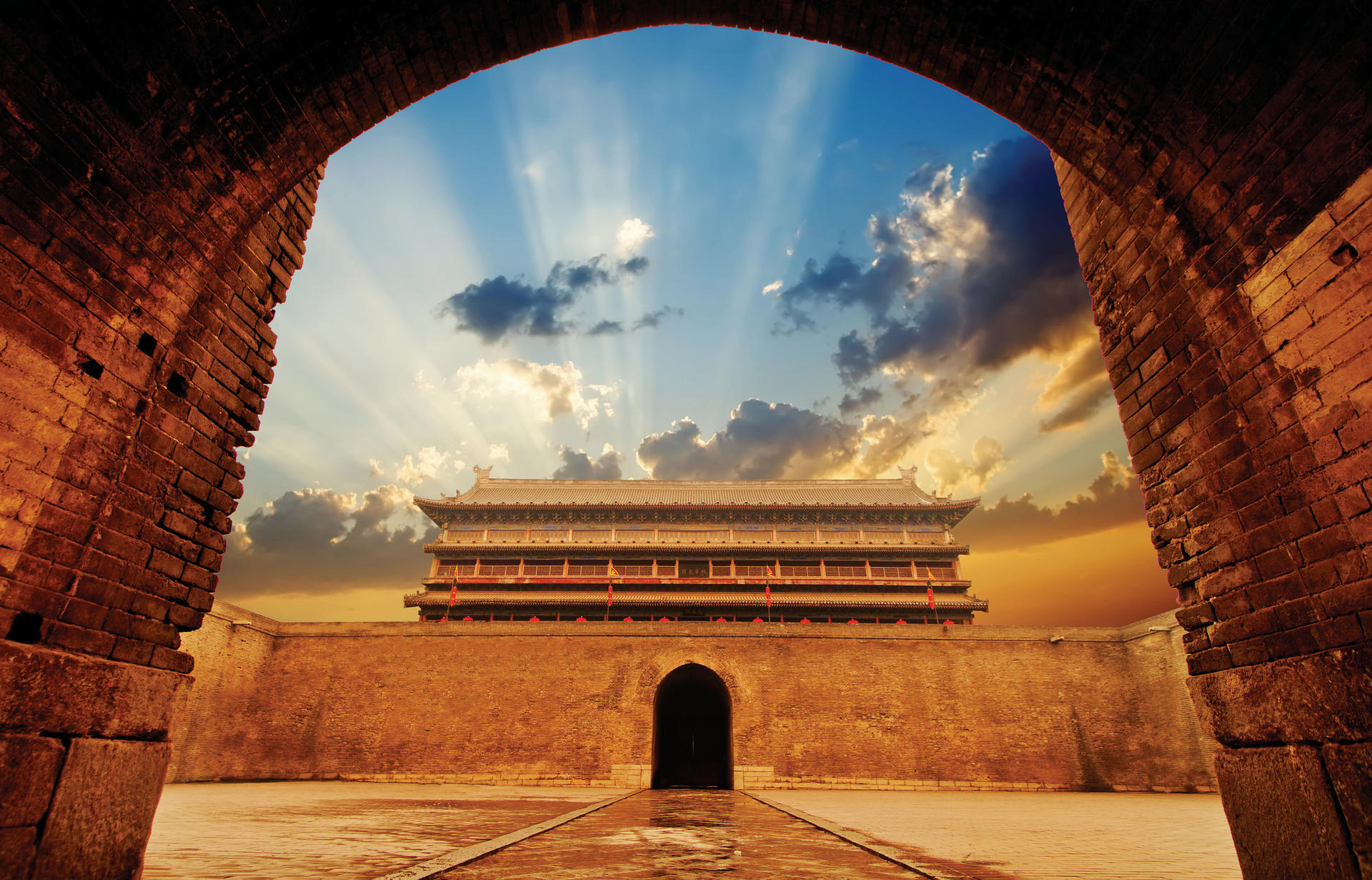
The Xi'an City Wall, also known as the Xi'an Ming City Wall, is a Ming Dynasty construction. The existing wall is 13.7 kilometers long, construction began in the third year of Hongwu (1370) under Emperor Hongwu of the Ming Dynasty, and was completed in the eleventh year of Hongwu (1378). It was built on the foundations of the Sui and Tang imperial cities, guided by Emperor Hongwu's policy of "building high walls, accumulating vast provisions, and delaying claiming kingship." Later, Emperor Hongwu Zhu Yuanzhang enfeoffed his second son, Zhu Shuang, as the Prince of Qin, with his fiefdom and administration located in the same city, resulting in a grand and sturdy city. Coupled with subsequent repairs and additions during the Ming and Qing dynasties, it remains well-preserved to this day. In early 2004, during the construction of the road project for the Hanguang Gate section of the Xi'an City Wall, the Shaanxi Provincial Institute of Cultural Heritage was commissioned by relevant departments to assist with the project. They conducted an archaeological survey of the exposed section of the city wall, identifying its complex structure, spanning from the Sui and Tang dynasties to modern times, having undergone five major renovations, and possessing significant historical value.

 Ask Slow Boat
 Ask Slow Boat